
Table of Contents
Key Takeaways
- Spermidine for brain restoration. It activates autophagy, which removes damaged proteins and dysfunctional mitochondria from brain cells before they can cause harm.
- Spermidine declines with age. Spermidine levels decrease by 50% from your early 20s to 70s, which increases your chances of age-related cognitive decline.
- Backed by Clinical research. Clinical studies consistently show that spermidine reduces amyloid-beta and tau tangles, increases BDNF, and maintains synaptic density in your hippocampus.
- Better memory. A randomized, placebo-controlled trial showed improved memory in older adults. Confirming earlier studies that show that Spermidine helps prevent age-related cognitive decline and improves long-term memory.
- Synthetic vs natural. Wheat germ extract is used in many supplements. But research shows that a synthetic form of Spermidine is more effective as a supplement.
- Spermidine is safe to use. Clinical studies show that using 1.2 mg of spermidine per day is safe. The European Food Safety Authority (EFSA) has approved doses of up to 6 mg per day.
Spermidine is a natural polyamine found in every cell of your body and brain. It was named after its discovery in human sperm. Spermidine is now recognized as one of the most promising nootropic compounds in modern longevity science.
Your body produces Spermidine, but levels decline as you get older.
This decline could result in reduced autophagy, increased inflammation, and the buildup of damaged proteins associated with Alzheimer’s disease and cognitive decline.
Recent clinical studies show promising results for boosting memory, especially in older adults.
In this Spermidine review, we’ll examine the evidence so you can decide if you should add Spermidine to your nootropic stack.
Spermidine helps:
- Autophagy and cellular cleanup. Spermidine is the strongest natural activator of autophagy known today. Autophagy is your brain’s internal recycling system. It breaks down and removes damaged proteins, dysfunctional mitochondria, and cellular waste that accumulate with age. This cleanup process is important for preserving healthy neurons. Without it, toxic proteins accumulate, and brain cells die.[i]
- Neuroprotection. Spermidine decreases the pro-inflammatory cytokines Tumor Necrosis Factor-α, Interleukin-1 βeta, and Interleukin-6 in your brain. A study in the Journal of Neuroinflammation in 2022 reported that increases in microglial activation, if left unchecked, increased the type of chronic brain inflammation that can cause diseases like Alzheimer’s and Parkinson’s.[ii]
- Memory and cognitive aging. Spermidine has been shown in animal studies to help preserve synaptic density, increase BDNF (brain-derived neurotrophic factor), and protect neurons in your hippocampus, which are responsible for memory and recall. A study published in the journal Scientific Reports in 2019 said that humans who supplement Spermidine could slow the loss of memory as they get older.[iii]
What is Spermidine?
Spermidine is a polyamine, which is a small, positively charged molecule involved in nearly every critical cellular process in the human body.
Polyamines are important for cell growth, DNA health, protein synthesis, and lowering cellular oxidative stress.
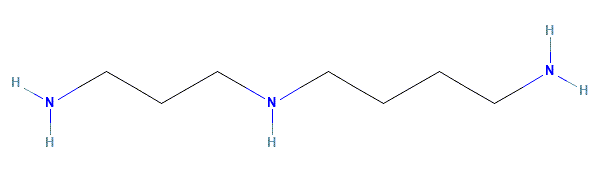
Spermidine is in the middle of the polyamine family. It is made from putrescine (a diamine) and is a precursor to spermine. All three polyamines are found throughout your body. But Spermidine has the highest amount among polyamines in the human brain.
Your body makes Spermidine from the amino acid methionine through the methionine cycle. Your gut microbiome also helps improve circulating polyamine levels by producing Spermidine from the food you eat.
Spermidine is primarily found in wheat germ, which contains up to 243 nmol/g. Other foods include soy, shiitake mushrooms, green peas, corn, aged cheese, chickpeas, and some fermented foods.
The problem is that Spermidine levels decrease with age. Spermidine levels decline about 50% from age 20 to your 70s.
This decline appears to be caused by the age-related drop in autophagy (the reduction of unhealthy cells). Researchers believe restoring Spermidine levels may be one of the most effective ways to reactivate the brain’s natural cleanup mechanisms.[iv]
 How does Spermidine work in your brain?
Spermidine improves brain health and function in several ways, but two stand out.
- Spermidine activates autophagy in neurons.
Autophagy, which means “self-eating,” is the process by which a cell breaks down and recycles its damaged parts.
This process is critical in your brain because neurons cannot simply divide and replace themselves. When autophagy fails, damaged proteins accumulate, mitochondria malfunction, and cells die.
Spermidine is the strongest natural activator of autophagy discovered so far. It works by inhibiting the enzyme EP300, a histone acetyltransferase that normally suppresses the activity of autophagy-initiating proteins.
When EP300 is inhibited, the autophagy cascade is triggered, which in turn increases the expression of autophagy proteins, including LC3, Beclin-1, and the ATG proteins that form autophagosomes and perform cellular cleanup.[v]
Researchers at Guangzhou University of Chinese Medicine studied Spermidine in SAMP8 mice, an accelerated aging model.
Mice that received Spermidine showed significantly improved memory, increased SOD antioxidant enzyme activity, reduced oxidative damage, and upregulation of autophagy proteins.
The researchers also found increased levels of brain-derived neurotrophic factor (BDNF) and Nerve Growth Factor (NGF), as well as improved synaptic density, all of which are associated with better learning and memory.[vi]
-
- Spermidine reduces inflammation and clears amyloid-β.
Brain inflammation, which happens from constant activation of microglia and astrocytes, is now known to be involved in the progression of Alzheimer’s disease.
 Overactivated microglia release pro-inflammatory cytokines, including Tumor Necrosis Factor-α, Interleukin-1 βeta, and Interleukin-6, which damage neurons and impair synaptic function.
Spermidine suppresses inflammation by supporting autophagy. When autophagy is active, microglial cells can more effectively engulf and clear away amyloid-β.
Researchers at Charité – Universitätsmedizin Berlin treated mice with Alzheimer’s with Spermidine. Using single-nucleus RNA sequencing, the team found that spermidine specifically targeted disease-associated microglia, shifting their state from inflammatory to healthy.
The researchers noted a significant reduction in amyloid-beta and inflammation. The researchers concluded that “Spermidine has the potential to improve Amyloid-β reduction and lower glial-mediated inflammation in Alzheimer’s Disease.”[vii]
Another clinical study conducted in 2023 at the University of Basel examined the effect of Spermidine on tau tangles, another defining characteristic of Alzheimer’s disease.
The researchers found that Spermidine improved mitochondrial function and restored mitophagy in cells expressing a disease-causing tau protein.[viii]
How things go bad when you are low in Spermidine
As Spermidine levels decline with age, autophagy becomes increasingly impaired, and the consequences of less Spermidine increase with age.
↓ Autophagy declines, which leads to the accumulation of damaged proteins in neurons.
↑ Amyloid-beta and tau buildup increase, which increases the risk for Alzheimer’s disease.
↑ Brain inflammation increases as microglia remain chronically activated.
↓ BDNF and NGF production declines, reducing synaptic plasticity.
↓ Mitochondrial function declines, resulting in a drop in mental energy.
↓ Memory and recall decline.
↑ Vulnerability to Parkinson’s, dementia, and age-related cognitive decline increases.
This is not a rapid decline. Instead, it is slow and takes decades before any symptoms appear.
And this is exactly why researchers are focusing on Spermidine as a preventative approach to starting early, while your brain still has the capacity for self-repair.
 Spermidine benefits
Spermidine is a potent autophagy inducer that supports maintaining healthy neurons. When autophagy functions well, neurons are better at clearing the protein aggregates that build up with age and, if left unchecked, are linked to Alzheimer’s and Parkinson’s disease.[ix]
Spermidine reduces the buildup of lipofuscin, a collection of oxidized proteins and lipids that accumulates in aging cells. Lower levels of lipofuscin in neurons are associated with better cognitive performance.
Spermidine supports your brain’s glutamate system. Polyamines, including Spermidine, act as modulators at NMDA receptors, the main glutamate receptors involved in long-term potentiation, the synaptic mechanism behind learning and memory.[x]
Spermidine increases BDNF and NGF, which are necessary for neuron repair, axon growth, synaptic plasticity, and hippocampal neurogenesis.
Reduced BDNF levels are associated with Alzheimer’s disease, can cause depression, and age-related cognitive decline.
Spermidine also shows strong antioxidant properties, lowering malondialdehyde (MDA) and increasing superoxide dismutase (SOD) activity in your brain.[xi]
Spermidine has been shown in several clinical studies, both in humans and animals, to prevent heart disease and reduce overall mortality.[xii]
And Spermidine has been shown to help fight hair loss and reverse grey hair.[xiii]
How does Spermidine feel?
 Many Spermidine users reported less hair loss, and several said their hair began growing again after 3 months of use.
Spermidine supplementation boosted energy levels and feelings of well-being.
One user suffering from traumatic brain injury reported that adding Spermidine to his current stack, including Fisetin, Apigenin, Berberine, Lion’s Mane Mushroom, and NMN, improved his short-term memory. He could now remember phone numbers long enough to write them down, something he hadn’t been able to do before.
Recuperation from workouts was easier, and energy throughout the day was higher.
After two weeks of supplementing Spermidine, energy levels increased, and mental clarity improved.
Spermidine Clinical Research
Spermidine improves memory
Researchers at Charité – Universitätsmedizin Berlin conducted a randomized, double-blind, placebo-controlled trial involving 30 older adults ages 60–80, who experienced subjective cognitive decline. This condition is recognized as a pre-clinical stage of Alzheimer’s disease risk.
Study participants received a Spermidine-based wheat germ extract (1.2 mg/day) or a placebo for three months. Memory was measured using the Mnemonic Similarity Task (MST), a test of hippocampal memory changes.
The group taking Spermidine showed improved memory performance compared with the placebo group.
The researchers attributed this to stimulation of neuromodulator actions in the memory system. The researchers reported no side effects.[xiv]
Spermidine supplementation is safe
The same research group published safety data from a three-month, randomized, placebo-controlled, double-blind clinical trial involving 30 older adults aged 60–80. And a study was conducted with mice at the same time.
At the end of the trial, there were no differences between the Spermidine and placebo groups.
The researchers concluded that the Spermidine supplement was “safe and well-tolerated” in both mice and older adults.[xv]
Spermidine for Alzheimer’s Disease
Researchers at Charité and the German Center for Neurodegenerative Diseases (DZNE) treated mice with supplemental Spermidine. Single-nuclei RNA sequencing showed that Spermidine targeted disease-associated microglia. The researchers found that this shifted the microglia from a neurotoxic inflammatory state to a cleanup state.
As a result, there was a significant reduction in amyloid-beta and a significant decrease in overall brain inflammation associated with Alzheimer’s disease.
The team suggested Spermidine as a possible therapeutic option for addressing inflammation in Alzheimer’s.[xvi]
Spermidine restores tau-related mitochondrial damage
Researchers at the University of Basel examined how disease-related tau protein affects neuronal mitochondria, which is relevant to Alzheimer’s and over 20 other tau-related pathologies.
Tau tangles decrease energy production and block the removal of damaged mitochondria.
The researchers showed that Spermidine improved mitochondrial respiration, mitochondrial membrane potential, and adenosine triphosphate (ATP) production. They also showed that Spermidine decreased free radical levels and increased autophagy.
The study authors concluded, “that Spermidine supplementation might represent an attractive therapeutic approach to prevent/counteract tau-related mitochondrial impairments.” [xvii]
 Spermidine recommended dosage
The recommended nootropic dose of Spermidine is 1 to 6 mg per day when using a standardized spermidine-rich wheat germ extract.
The European Food Safety Authority (EFSA) approved spermidine-rich wheat germ extract as a Novel Food in 2021. And set a safe upper limit of 6 mg of Spermidine per day.
Clinical trials have used doses of 0.9 to 1.2 mg daily for 3-12 months in older adults, with good tolerance.
I recommend starting with 1 to 2 mg Spermidine per day and seeing how you feel over 4 to 6 weeks before increasing your dose.
There is no established preference for using Spermidine in the morning or evening.
But one recent clinical trial used Spermidine at bedtime, which may be a good option if you are using it to support long-term memory during sleep.
Spermidine side effects
Spermidine is non-toxic and safe to use by most people.
The most commonly reported side effects are nausea, bloating, and mild digestive issues.
Users supplementing Spermidine have not reported any side effects, including in human clinical trials at doses up to 6 mg per day.
If you have celiac disease, non-celiac gluten sensitivity, or a wheat allergy, make sure the Spermidine product you choose is a purified form rather than a wheat germ-based extract.
Pregnant or breastfeeding women should talk to their doctor before taking Spermidine, because safety data in these groups is not yet available.
Best Type of Spermidine to buy
Spermidine-rich wheat germ extract is the most used form in most human clinical trials.
Longevity Labs’ spermidineLIFE® is one of the company’s manufacturing Spermidine supplements with clinical backing, and it is the most widely used extract in clinical studies. It is standardized for a specific Spermidine content of 2 mg.
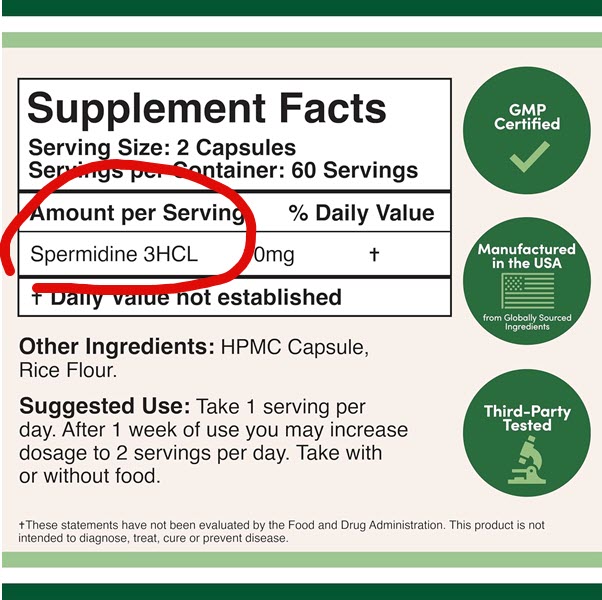
High-purity Spermidine 3HCL (trihydrochloride) is a newer synthetic version that offers higher, more precise doses.
A 2024 clinical study involving older men used 40 mg of Spermidine 3HCl daily and reported that it was well tolerated, with no side effects.[xviii]
I highly recommend looking for a Spermidine 3HCl supplement that clearly shows the standardized Spermidine content (not just the amount of wheat germ extract).
Please ensure the company can provide proof of third-party testing and is willing to provide a copy upon request. And if you are in Europe, the company has the European Food Safety Authority (EFSA) stamp of approval.




Join The Discussion - 2 comments
Carolyn Moshier
June 18, 2026
Thank you for the help you give us. I have memory problems. On your website I put in a search for MNM and and came up with Spermidine. Is this the same as MNM? I have recently purchased Dr. Love’s MNM and didn’t know if I could take this also in the morning with Igniton Cognition. I also take Aniracetam in the morning with ALCAR and choline. I am afraid to take my 12 mg Methylene Blue in the morning because of what I am already taking. Some of the other supplements I take regularly are Tumeric, mega 3, Vitamin D3, Magnesium at bedtime, B-12 and Folate, and Multi-vitamin. What do you think? I do plan on a consultation at some time in July, but need to know about these things now. I did take my first MNM this morning and could feel a positive difference. Again thank you for your invitation on a consultation.
David Tomen
June 18, 2026
Carolyn, I’m happy that you ended up here no matter how it happened. NMN and Spermidine are two very different supplements. NMN is a precursor to NAD+ which declines as we get older. Check out my review for niacin to see more on how this works. You can read all about Spermidine in the article above.
You can take NMN in the morning with igniCognition and ALCAR, Turmeric, and the other supplements you mentioned. Don’t forget there is a dose of CDP-Choline and Alpha GPC in igniCognition so there is no need to use your choline supplement at the same time.
Magnesium is good to take before bed because it helps you sleep. And I look forward to working with you in July Carolyn. Let me know if you have any other questions or if we can save it for when we talk in July.